Misinformation and Health Care: A Brief History
Muddled Messaging on Climate | Surfing in Alaska | A Zero-Waste Town
By David Eaton and Peter Glenshaw
MISINFORMATION AND HEALTH CARE: A BRIEF HISTORY
by Peter Glenshaw
It’s been an important week for women and health care.
With the Supreme Court now likely to reverse its 50-year-old precedent protecting the reproductive health rights of women, it bears understanding how far we’ve drifted from medical science in this debate. And to understand how far off course we are, it’s useful to remind ourselves about the history of one very specific aspect of women’s health care: hand hygiene.
Maybe you missed the announcement, but yesterday was World Hand Hygiene Day, according to the World Health Organization.1
It’s OK if you missed this date (after all, there are so many dates and days to remember; it can be a bit overwhelming).
Nevertheless, the origin of hand hygiene as a standard medical practice is worth remembering. As one study put it, “hand hygiene is the most important measure to avoid the transmission of harmful germs and prevent health care-associated infections.”
And yet, the adoption of hand hygiene in women’s health care nearly did not happen. In fact, the practice of hand hygiene in obstetrical and gynecological care had to overcome a deliberate misinformation campaign led by men more than 150 years ago.
Sound familiar? Read on.

Ignaz Semmelweis was a Hungarian physician who worked in an obstetric clinic in Vienna after receiving his medical degree in 1844.2 At the time, puerperal infection, aka postpartum infection, was the top medical challenge in European maternity wards, responsible for the deaths of 25-30 percent of women who gave birth in hospitals.3
The cause of these infections was unclear, and the medical establishment at the time accepted this problem as insolvable. Semmelweis noticed, however, that mortality rates varied depending upon who treated the maternity patients: physicians-in-training or midwives. The student doctors, he observed, often did not wash their hands before attending to pregnant women in the maternity ward. Semmelweis noticed, too, that many of them arrived in the maternity ward directly from the dissection clinic. He ordered students to wash their hands in chlorinated lime. The mortality rates in these maternity wards dropped below two percent.
Unfortunately, the medical establishment in Europe rejected Semmelweis’s practice. One important medical journal wrote that it was time to stop this nonsense about hand washing. Despite publishing several letters and monographs about the medical benefits of hand hygiene, the ongoing rejection by his peers caused Semmelweis to suffer a nervous breakdown. He was committed to a mental hospital where he was beaten by staff, leading to an infection in his hand that ultimately killed him. More than 20 years after his death, and after countless avoidable fatalities among maternity ward patients, the medical establishment adopted Semmelweis’s hand-washing protocol as standard medical practice.
It’s tempting to think about this story as an historical artifact—a novelty of ignorance that could not happen today. Yet we know the COVID-19 pandemic fostered an extraordinary amount of misinformation that was spread and accepted both by experts and the general public.
Just this week, for instance, the New Hampshire Senate passed a bill that would allow anyone to secure a prescription for the heart deworming drug ivermectin despite numerous well-run clinical trials that show no benefit to COVID-19 patients.4 5 New Hampshire State Sen. Tom Sherman (D-Rye), the Senate's only medical doctor, said voting for the legislation is equivalent to malpractice.
"This is an area of expertise for me," Sherman said. "I'm not speaking as a state senator. I'm speaking as a doctor who's a gastroenterologist, board-certified and licensed, and this is a really bad idea."
A similar phenomenon exists in the debate over repealing Roe v. Wade. That decision, along with Casey v. Pennsylvania, relied on medical science to define fetal viability and the rights that were conferred upon a woman until that moment occurred.
Fact check: fetal viability—defined as the ability of a fetus to survive outside the womb with medical intervention—is generally defined by the medical community as 23-24 weeks gestational age.6
And yet this debate over a woman’s reproductive health has not been defined by medical science. Instead it has been dominated, both this week and for decades prior, by legal arguments over when life begins, and if a woman should have the right to make decisions about her personal health care.
This framing amounts to a misinformation campaign. It replaces the accepted medical science of fetal viability with a set of personal and religious beliefs that life begins at conception and women should not have dominion over their own health care.
It’s all terrifyingly similar to the medical establishment’s response to Semmelweis and his advocacy of hand hygiene more than a century ago. In his time, those in positions of influence and authority ignored medical science, favoring their own views that cleanliness of a provider’s hands made not a whit of difference to the health of the patient.
Are we not doing the same today with fetal viability?
Whether it’s hand hygiene, COVID-19 therapeutics or fetal viability, history shows that the humankind has a bias towards ignoring medical science in favor of personal, religious beliefs that have little to no grounding in fact.
How has that turned out for us?
Ask the women who died unnecessarily and prematurely from poor hand hygiene in those 19th century maternity wards.
Ask the COVID-19 patients who took Ivermectin, did not improve, and may have suffered worse fates, including death.7
And, ask the women who became pregnant and wanted to follow medical science regarding fetal viability, but were told they had to obey the dictates of a misinformation campaign rooted in personal, religious beliefs.
MUDDLED MESSAGING ON CLIMATE
by David Eaton
This newsletter devotes a fair bit of copy to climate change, or, as Peter and I prefer, climate disaster. Our attention to climate disaster is reflective of its importance as an issue, and its tangible presence in our lives despite living in very different communities separated by a vast and diverse geography.
Peter and his family live in a small town of roughly 1,800 in New Hampshire, a verdant locale with four clearly defined seasons. My family and I live with 10 million others in Los Angeles county, a desert with two seasons: hot and dry alternating with less hot and a bit less dry (in a good year).
But we both see and feel the effects of climate disaster. Peter’s summers are warmer and wetter while winter is increasingly characterized by erratic snowfall. In Los Angeles, summer is noticeably hotter today than it was a mere ten years ago and the reliable rains that characterized my childhood winters here are, well, they are no longer reliable.
And this, to us, is the challenge of reporting on and writing about climate disaster; it affects each of us differently though the consequences of failing to address it will affect all of us collectively. The politicization of climate disaster has not helped efforts to communicate what is happening and what each of us can do to change.
Lin Warfel is a fourth-generation soybean farmer in Illinois who sees climate disaster in his fields every day. He’s taking steps to do what he can to mitigate it, but he does not talk about it. Not in those terms.
“We don’t use the words climate change,” said Steve Stierwalt, an Illinois-based farmer and co-founder of Saving Tomorrow’s Agriculture Resource (STAR), the organization that helped Warfel introduce more sustainable farming practices. And you’ll find no mention of climate change on the STAR website.
“In the agricultural community that becomes a political term,” Stierwalt told St. Louis Public Radio.8
Ipsos, a polling outfit, conducts an annual global survey timed for release on Earth Day.9 This year’s findings are instructive in understanding the disconnect between what we, as individuals, believe must be done to address climate disaster and what we, as individuals, are actually willing to do.
62% of respondents in the US said the government will be “failing the people” if it does not “act now to combat climate change.”
55% of US respondents believe it “likely” the country will make significant progress against climate change this decade, but only 27% say “government has a clear plan” to attack climate change.
61% agree they “will be failing future generations” if they do not act now, as individuals, to combat climate change.
Only 33% of US respondents said they’d be willing to use sustainable transportation (walking, cycling or public transport) “to limit [their] own contribution to climate change,” and less than a third, 32%, said they be willing to travel by air less or not at all.
Changing dietary habits scored equally low among the actions Americans are willing to take personally to combat climate change: 33% said they’d be willing reduce meat consumption while 31% are willing to eat fewer dairy products.
And, less than half those surveyed in the US said they are “likely” to take steps to reduce energy consumption in their homes “to limit your own contribution to climate change.”
Transportation, agriculture and electricity generation accounted for 63% of all greenhouse gas emissions in the US in 2020, according to the EPA.10
Lastly, in response to the question “How much do you think the climate of the Earth has warmed since 1850, if at all?” 62% of American said they did not know—the highest rate of climate disaster ignorance among the 31 countries polled by Ipsos.
To sum: Americans believe climate disaster is real and that it must be addressed. They also believe it is government’s responsibility to lead on this issue, but only a quarter of those polled think our elected leaders have a plan. And, finally, while we believe climate disaster is a problem and must be addressed, we are generally unwilling personally to make meaningful changes in our lives to combat climate disaster.
It’s all a bit schizophrenic but does beg the question: if there were clear, consistent, actionable direction from the government Americans believe should be leading on climate disaster, would we Americans be more willing to change our behavior? I’m not sure we’ll know the answer to that one until we can take the politics out of climate disaster…. or the Earth gets too warm for our continued existence.
PERSPECTIVE: MORTGAGE RATES
As I write this Thursday afternoon, a day after the Federal Reserve raised interest rates .5%, the average annual rate for a 30-year fixed rate mortgage is 5.48%, according to BankRate.com.11 A year ago this month it was 3.06%.
That’s a big increase, particularly if one is trying to purchase a home for the first time. The median price of homes sold in the US during the first three months of 2022 was $428,700, according to the Federal Reserve Bank of St. Louis.12 At last April’s rate, the monthly payment on our hypothetical median home is $1740; today it would be $2226.13 A difference of $486. For some would be buyers, that additional $486 a month is the difference between being able purchasing a home and not.
While higher than a year ago, even at 5.48%, the rate on a 30-year mortgage remains well below its 40+ year average, as the graph below illustrates.
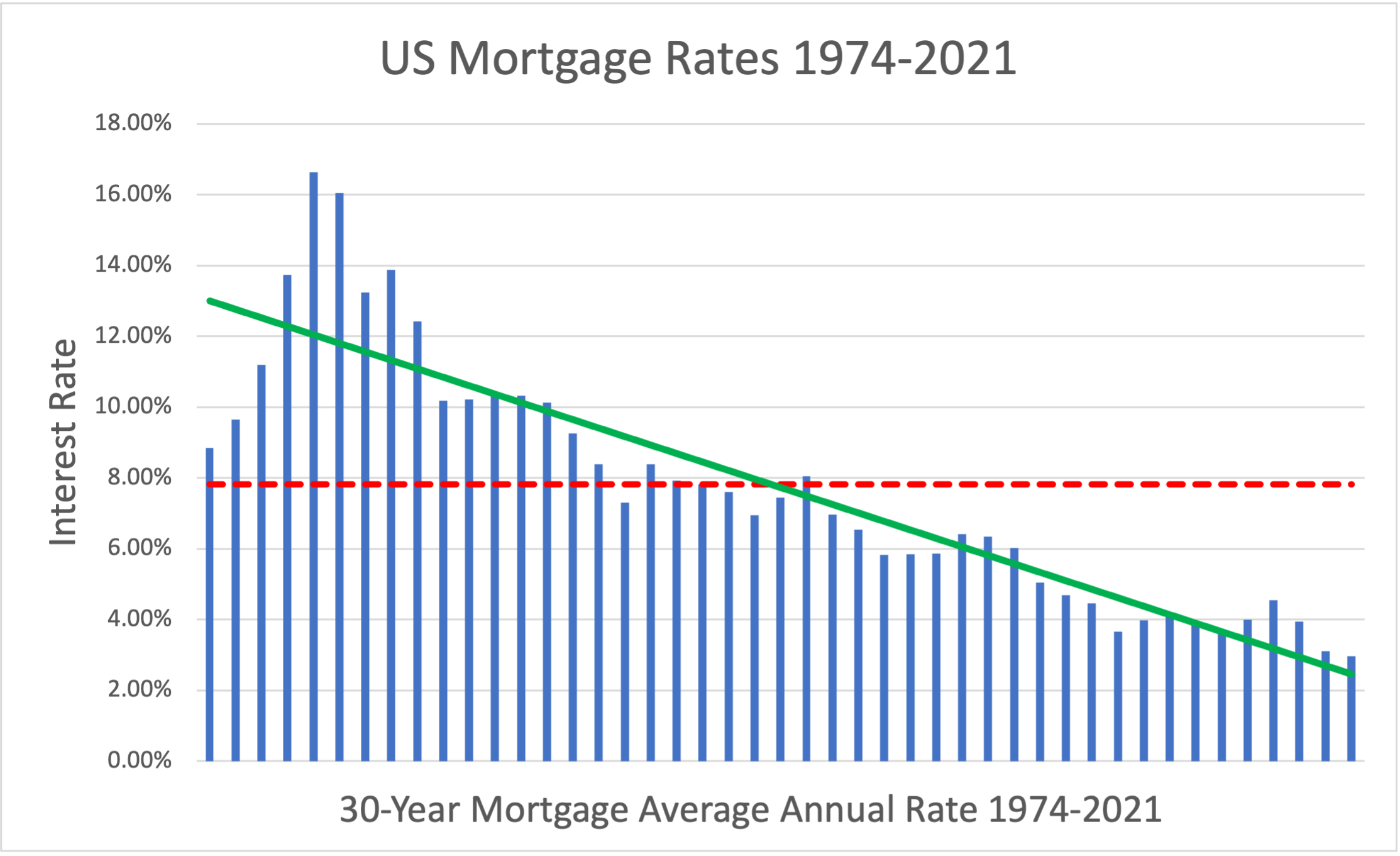
Each blue bar represents the annual average rate on a 30-year mortgage. The green line illustrates the steady downward trend of 30-year mortgage rates since 1974. The dashed red line is the historical average of 6.81%. Rates today are definitely going up, pricing out some would-be homeowners, but the cost of borrowing to purchase a home remains well below its multi-decade average.
Admittedly, that’s of little solace to folks trying to buy a place to live today.
Perspective.
BRIEFS:
MAKING A DIFFERENCE… Our changing climate is the greatest existential threat we face. It is also a hugely complex issue, as the Ipsos poll we wrote about makes clear, that is not well understood in the US. But, take heart. It is possible to make a difference. Kamikatsu, a small town in Japan, declared in 2003 that it would be “zero waste” by 2030. Today its 1,500 residents are 80% there. Yes, Kamikatsu is a community of 1,500, not 15 million, but “its residents have a lot to teach about living more sustainably, and many of the measures they have adopted could be scaled up in larger cities.” Momona Otsuka, the 24-year-old chief of Kamikatsu’s “Zero Waste Center,” says there are two keys to creating a culture of recycling and re-use: government policy and community support. When looked at through that lens, making a difference as individuals does not seem impossible, particularly if there is a willingness to change behavior and clear direction from leaders. Here is a well-reported Washington Post piece that explains how Kamikatsu has done it. Contrast it with this report that Americans recycle less plastic today than they did just a few years ago. Beware the whip-lash.
THE FORGOTTEN BACKBONE… The third decade of megadrought is bringing change to the vast agriculture industry that accounts for about 80% of all water use in California. Some farmers are choosing not to plant this year. Others are ripping out water-intensive crops such as almonds because there isn’t enough water to keep them alive. All told, nearly one million acres of farmland in California’s San Joaquin Valley will be taken out of production due to a lack of water, according to some estimates. Lost in all of this is the fate of the people who work the fields—the literal backbone of the most productive agricultural economy in country. There are more than 165,000 farmworkers in the Valley and little thought has been given to their fate as California’s multi-billion dollar agriculture industry undergoes seismic change. “We just don’t think you can plan to transition land without also planning to transition the workers that will be impacted when the land gets fallowed,” said Nataly Escobedo Garcia, water policy coordinator at nonprofit Leadership Counsel for Justice and Accountability. “We need to get on it now. We can’t keep leaving farmworkers out of these conversations.” SJV Water, a news organization covering the San Joaquin Valley, has an informative piece on what could be done for the people whose labor built the Golden State’s agriculture economy, and what little actually is being done.
CATCH A WAVE… They are some of the best-known surf breaks in the world—Pipeline, Rincon, Maverick’s, Teahupo’o, Kuta and Uluwatu—made famous in film and song. Add Yakutat to the list. Wait. What? Yaku-who? Yakutat is a small community on Alaska’s southeast coast featuring world class waves crashing onto a beach backed by temperate rain forest. “It’s pretty amazing when you can be in the water and you’re surfing, and you look down, and there’s salmon that are swimming underneath you,” says Freddie Muñoz. “I’ve surfed in Australia, in Panama. I’ve surfed in Hawaii. I’ve been to these places — and it’s been incredible.” But, Muñoz chooses to surf in Yakutat, where he’s lived for the past 15 years. You can read a delightful Alaska Public Media story about surfing in a place that redefines the term “North Shore.” Kawabunga, dude.
ICMYI:
WORKING FOR FREE NO MORE… Flight attendants (FAs) are paid for their work once the aircraft doors close. The are not paid during the often-chaotic boarding process; that work they do for free. But this age-old practice is about to change at one major US air carrier. Beginning June 2nd, Delta Air Lines, will compensate flight attendants for their work during a 40 minute “boarding window,” albeit at a reduced hourly rate, reports Bloomberg. Here at Perspective we’re just about 100% certain this change by Delta—the only major US airline with non-union flight attendants—has nothing to do with an ongoing effort to unionize its cabin crews. BTW, that bridge over there—it’s for sale. Make us an offer.
Assuming a 20% downpayment.